Credit & Banking
What Is a Good Credit Score?
Learn what credit score ranges mean, what counts as a good score, and how lenders actually use your number when you apply for credit.
A good credit score is generally anything at or above 670 on the standard 300-850 scale. If you're in that range, most lenders will approve you for mainstream credit products. The higher you go above 670, the better your rates tend to be.
That's the short answer. The longer one involves understanding what the numbers actually mean, why scoring models differ, and what changes when you move from one band to another.
Credit scores matter more than most people expect. They affect the rate you pay on a car loan, whether a landlord approves your application, and in many states, what you pay for auto insurance. A score in the good range isn't just a label. It's a number that costs or saves you real money over time.
This article is general information, not financial advice. Credit decisions depend on lender policies and your full financial picture.
At a Glance
- 670+ is "good" on the standard 300-850 scale used by both FICO and VantageScore.
- 740+ unlocks better pricing. Below 740 you'll still get approved for most products, just at a slightly higher rate.
- Payment history and utilization drive 65% of your FICO score (35% and 30%, respectively). Focus there first.
- You don't have one score. You have dozens, depending on the model, version, and bureau a lender pulls.
- Checking your own score never hurts it. Only hard inquiries from new credit applications shave off a few points, and even those fade within a few months, according to the Consumer Financial Protection Bureau.
- Lenders, landlords, insurers, and some employers all pull credit data, not just banks.
The standard credit score range
Most consumer credit scores in the US run from 300 to 850. That range comes from FICO, which introduced the scoring formula in 1989. VantageScore, the other major model, uses the same 300-850 range (its earlier versions used different scales, but VantageScore 3.0 and 4.0 match FICO's range). The CFPB defines a credit score simply as a prediction of your credit behavior, most often how likely you are to pay a loan back on time, built from the information in your credit reports.
A score of 300 is rare and reflects serious delinquency or very limited credit history. A score of 850 is a perfect score, also rare. Most Americans land somewhere in the 600s to mid-700s.
The credit score chart: bands and what they mean
| Score range | Common label | What to expect |
|---|---|---|
| 300-579 | Poor | Many lenders decline. Secured cards, credit-builder loans, or a co-signer may be needed. |
| 580-669 | Fair | Approvals possible but rates are higher. Fewer product options. |
| 670-739 | Good | Approved for most standard credit products at decent rates. |
| 740-799 | Very Good | Better rates, higher limits, easier approvals. |
| 800-850 | Exceptional | Lenders' best rates and terms. |
These bands are the ones FICO uses publicly. VantageScore uses slightly different labels (Subprime, Near Prime, Prime, Superprime) but similar numeric cutoffs.
Illustrative cost of each band
The bands above aren't just labels. They translate into what you actually pay. This table uses rounded, illustrative figures to show the general pattern lenders describe publicly; your actual quote depends on the lender, loan type, and the rest of your file.
| Score band | $25,000 auto loan, 60 months | $350,000 mortgage, 30 years |
|---|---|---|
| 580-669 (Fair) | Meaningfully higher rate than Good tier | Higher rate, often requires mortgage insurance |
| 670-739 (Good) | Standard market rate | Standard rate, PMI likely if down payment is small |
| 740-799 (Very Good) | Roughly 1-2 points lower than Fair tier | Noticeably lower rate, easier PMI removal terms |
| 800-850 (Exceptional) | Lender's best-tier rate | Lender's best-tier rate, most flexible underwriting |
The takeaway isn't the exact numbers, which shift with the rate environment, it's the pattern: each band up generally buys you a cheaper loan, and the mortgage gap compounds the most because of the longer term.
What "good" actually means in practice
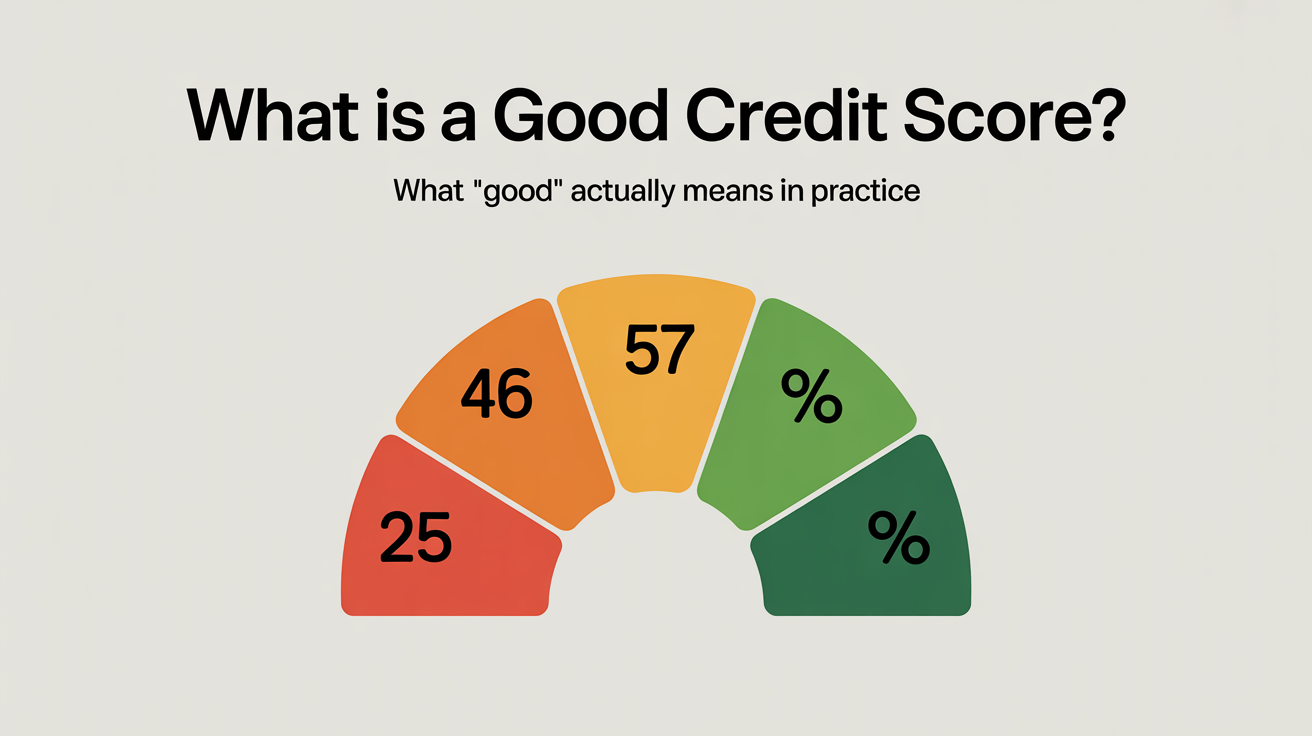
A score in the 670-739 range gets you approved for most credit cards, auto loans, and personal loans. You won't always get the lowest advertised rate, but you won't be stuck with predatory terms either.
The difference between good and very good is real money. On a $25,000 auto loan over 60 months, a borrower with a 740 score might get a rate 1.5 to 2 percentage points lower than someone at 680. Over five years, that adds up to several hundred dollars.
For mortgages, the gap is wider. Lenders typically use tiered pricing called loan-level price adjustments, and moving from the 680-699 band into the 720+ band can lower your interest rate meaningfully. On a 30-year mortgage, even a quarter-point rate difference affects the total interest paid by thousands of dollars.
Below 670: what changes
Lenders don't automatically say no if your score is below 670, but your options narrow. You may face:
- Higher interest rates to offset the perceived risk
- Lower credit limits
- Requests for a larger down payment (for auto loans or mortgages)
- Approval only for secured products, where you put up a deposit
Some lenders specialize in borrowers with fair or poor credit. The rates they charge reflect the risk they're taking on. Credit unions and community banks sometimes have more flexible underwriting than big national lenders, so it's worth checking with them if you're in this range and have an existing relationship.
Above 740: diminishing returns
Once you're solidly in the very good range, each additional point matters less. The difference between 750 and 800 is smaller than the difference between 650 and 700. Some lenders cap their best-rate tier at 720 or 740. Chasing 850 isn't worth stressing over.
How credit scores are calculated
FICO breaks its scoring formula into five components. Knowing the weights helps you understand where to focus if you want to move your number.
- Payment history (35%): Whether you pay on time. Late payments, especially recent ones, do the most damage. A single payment 30 days late can drop a strong score by 60-100 points; the same miss barely dents a score that's already low.
- Amounts owed (30%): How much of your available credit you're using, called credit utilization. Lower is better. Most advice suggests staying below 30%, though 10% or lower is typical among people with very high scores. Utilization is calculated per card and overall, so maxing out one card can hurt even if your total balance across all cards looks fine.
- Length of credit history (15%): How long your accounts have been open. Older accounts help, which is why closing your oldest card, even one you rarely use, can quietly lower your average account age.
- Credit mix (10%): Having both revolving accounts (credit cards) and installment loans (auto, mortgage) tends to help a little.
- New credit (10%): Recent applications create hard inquiries, which temporarily lower your score by a few points.
VantageScore weighs these factors differently, but payment history and utilization dominate both models.
If your score is lower than you'd like and you want practical steps to raise it, see our guide on how to improve your credit score.
Different scoring models, different numbers
Your credit score is not one single number. It depends on which model the lender uses and which of the three major bureaus (Equifax, Experian, TransUnion) supplied the underlying data.
FICO alone has dozens of versions: FICO Score 8 is the most widely used for general credit decisions, but mortgage lenders often pull FICO Score 2, 4, and 5 (one from each bureau). Auto lenders may use FICO Auto Score 8. Each version weights certain factors differently.
This is why your score might be 710 on one free monitoring service and 724 on another. Neither number is wrong. They just come from different models or bureaus.
Practically speaking, you don't need to track every version. Monitoring one score consistently through a free service like your bank's app or AnnualCreditReport.com, the only site authorized by federal law to provide your free annual credit reports from Equifax, Experian, and TransUnion, gives you a reliable direction of travel. The exact number matters less than the trend.
Where scores are used beyond lending
Lenders aren't the only ones looking at your credit.
Landlords often pull credit reports (sometimes scores) when you apply to rent. A low score can mean a larger security deposit or a declined application.
Insurance companies in most states use credit-based insurance scores to set premiums for auto and home insurance. Per the Federal Trade Commission, these insurance scores pull from your credit report but use a different formula than lending scores do, weighing things like payment history and how close you run to your credit limits.
Employers in some industries check credit reports (not scores) for roles involving financial responsibility. They need your consent and can only see the report, not the number.
Utility providers sometimes check credit before setting up service, and may require a deposit if your history is thin or negative.
Building good credit isn't just about qualifying for loans. It affects several ordinary parts of life.
If you're thinking about where to keep money while you build credit or save up, our articles on high-yield savings accounts and checking vs. savings accounts cover the basics.
FAQ
What credit score do I need to buy a house?
For a conventional mortgage, most lenders want a score of at least 620, though some go lower. To get the best available rates, you generally need 740 or higher. FHA loans allow scores as low as 500 with a 10% down payment, or 580 with a 3.5% down payment, though individual lenders often set their own minimums above the FHA floor.
Is 700 a good credit score?
Yes. A 700 score falls in the "good" range (670-739) and gets you approved for most standard credit products. You may not qualify for a lender's absolute lowest rate, but you'll have access to competitive options. Moving from 700 into the 740+ range will open up somewhat better terms.
How often does my credit score change?
Credit bureaus update their data as lenders report it, which usually happens once a month per account. Your score can change each time new information is reported. A large balance change, a new account, or a missed payment can all shift it. Day-to-day, the number is relatively stable unless something significant happens.
Does checking my own credit score hurt it?
No. Checking your own report or score creates a "soft inquiry." As the CFPB puts it, checking your own credit report is not an inquiry about new credit, so it has no effect on your score. Hard inquiries, triggered when a lender checks your credit after you apply, do lower your score slightly, typically by a few points, and they stay on your report for two years (though their impact fades after a few months).
What's the fastest way to raise a low credit score?
Paying down credit card balances is usually the fastest lever. Utilization changes month to month as balances are reported, so reducing what you owe relative to your limits can move your score in 30 to 60 days. Catching up on any past-due accounts helps too. Longer-term, consistent on-time payments are what build a genuinely strong score over time. There's no shortcut that works safely. For a step-by-step approach to paying off credit card debt, that guide walks through the strategies that move the needle fastest.
Can I have a good score with a short credit history?
It's harder, but not impossible. Length of history is only 15% of a FICO score, so a borrower with two years of on-time payments and low utilization can already land in the "good" range. What usually holds newer borrowers back is a thin file overall (too few open accounts for the model to score confidently) rather than the age of any one account. Adding a second account type, such as a small installment loan alongside a credit card, tends to help once payment history is established.