Saving Money
Practical Ways to Save Money on Groceries
Cut your grocery bill without extreme couponing. Practical tactics: meal planning, unit pricing, store brands, waste reduction, and a cheap staples list.
Most people overspend at the grocery store not because they're careless, but because the store is designed that way. Eye-level placement, bulk deals that aren't deals, and the sneaky cost of food that rots before you eat it all chip away at your budget quietly.
The good news: you don't need couponing binders or a second freezer to spend less. A few consistent habits will lower food costs by 20–30% for most households.
At a Glance
- Plan meals before you shop. A specific list built around what you already have is the single highest-leverage habit on this list.
- Compare unit price, not sticker price. Stores are required to post it on the shelf tag in most states, and it's the only honest way to compare sizes and brands.
- Food waste, not overspending on any one item, is usually the biggest hidden drain. The average household throws away roughly 30-40% of the food it buys.
- Store brands are functionally identical to name brands for most pantry staples (flour, canned goods, frozen vegetables, dairy).
- Freezing food correctly turns "use it or lose it" into "use it whenever," and it's the most underused tool in most kitchens.
- Shopping hungry, shopping with the whole family, and buying convenience-cut produce are small habits that quietly add 10-20% to a bill over a month.
Plan before you shop
This one sounds obvious. It also works better than almost anything else.
When you walk into a store without a list, you buy what looks good. When you walk in with a list built around meals you've already planned, you buy what you need. The difference shows up immediately. USDA's nutrition.gov budget resources put it plainly: making a plan before you head to the store is the first step in nearly every money-saving strategy they recommend, ahead of coupons, sales, or bulk buying.
Build a weekly meal plan first
Spend 10 minutes on Sunday (or whenever your week resets) writing down dinners for the week. You don't need to plan every meal, just the ones where you'd otherwise default to takeout.
Check what's already in your fridge and pantry first. Odds are there's something that needs to be used before it turns. Build at least one meal around that. USDA's meal-planning guidance frames this as "shopping with meals in mind," a small mental shift that also happens to be one of the more effective ways to cut food waste, since you're buying against a plan instead of against a mood.
Write a specific list and stick to it
Vague lists like "chicken" or "vegetables" leave too many decisions for the store floor, where you're tired and hungry and the rotisserie chicken smells amazing. Write specific quantities: "2 lbs boneless thighs," "one head of broccoli."
Then stick to it. Not every trip, but most of them.
Read the unit price, not the sticker price
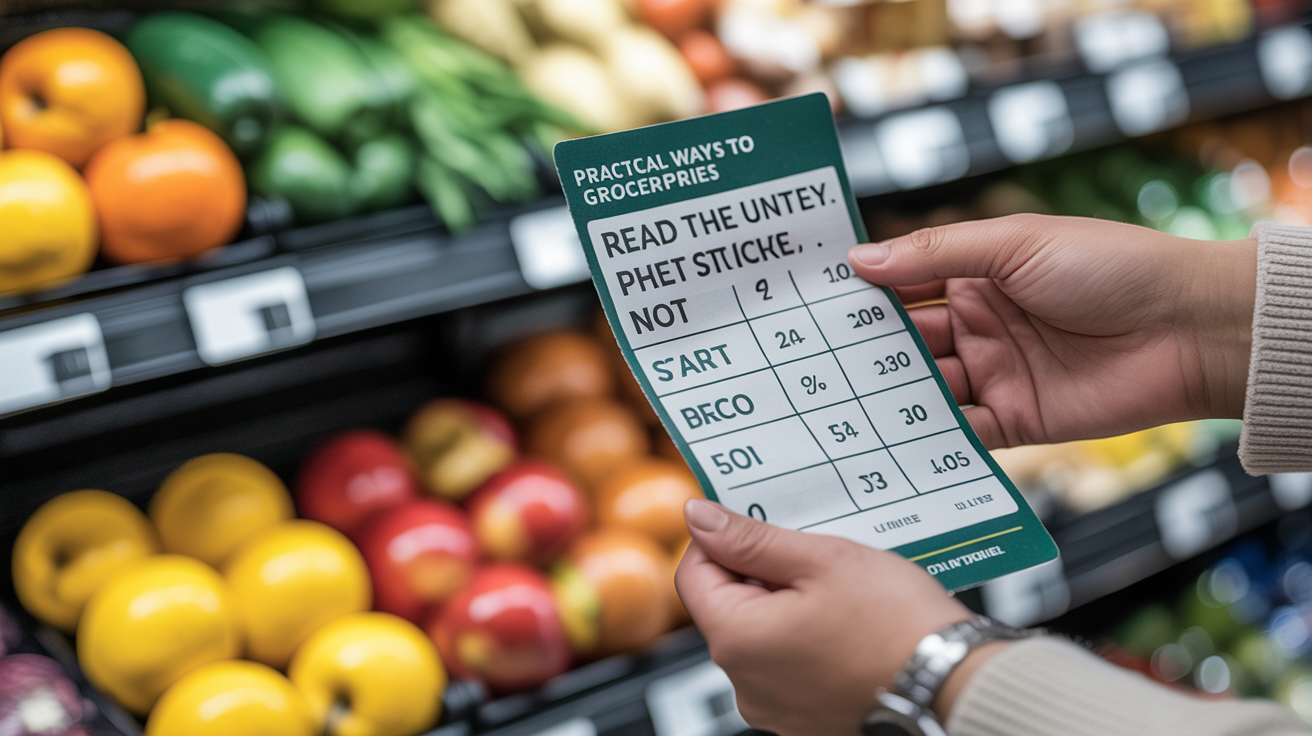
The big box of cereal looks cheaper than the small one. Sometimes it is. Sometimes it isn't. The only way to know is the unit price, which grocery stores are required to display on the shelf tag in most states.
Unit price is cost per ounce, per pound, or per count. Compare that number across sizes and brands, not the total price. A store-brand 32 oz container of yogurt at $3.49 ($0.109/oz) beats a name-brand 24 oz container at $3.29 ($0.137/oz), even though the name brand costs less at checkout.
This habit alone catches a lot of sneaky pricing. Here's what it looks like across a few common items where package size varies by brand:
| Item | Package | Price | Unit price | Cheaper option |
|---|---|---|---|---|
| Cereal (name brand) | 12 oz | $4.79 | $0.399/oz | baseline |
| Cereal (store brand) | 18 oz | $4.29 | $0.238/oz | Store brand, by 40% |
| Olive oil (small bottle) | 16.9 oz | $8.99 | $0.532/oz | baseline |
| Olive oil (large bottle) | 33.8 oz | $14.99 | $0.443/oz | Larger bottle, by 17% |
| Shredded cheese | 8 oz | $3.99 | $0.499/oz | baseline |
| Block cheese | 16 oz | $5.49 | $0.343/oz | Block, by 31% |
The pattern repeats across most categories: bigger isn't automatically cheaper, and convenience formats (shredded, sliced, pre-portioned) almost always carry a per-ounce premium over the same food in its plainest form.
When bulk buying makes sense
Bulk purchases save money only on items you'll actually use before they expire. Non-perishables (rice, pasta, canned goods, toilet paper) are good candidates. Fresh produce bought in bulk when you only needed a little is just expensive compost.
Switch to store brands on the right items
Store brands have improved a lot. For pantry staples, the quality difference between name-brand and store-brand is often nothing. For a few things, it matters.
Items where store brands work fine for most households:
- All-purpose flour, sugar, salt
- Canned tomatoes, beans, corn
- Dried pasta and rice
- Frozen vegetables
- Butter and eggs
- Milk and basic dairy
- Cooking oil
- Spices (especially the ones you use infrequently)
Items where you might prefer the name brand:
- Certain condiments (hot sauce, mustard) where you have a strong preference
- Specific snacks you buy for the brand experience
The rule: try the store brand once. If you can't tell the difference, stick with it. If you notice and it bothers you, go back. Most of the time you won't go back.
Reduce food waste
The USDA estimates that American households throw away roughly 30–40% of the food they buy. If your grocery budget is $600/month, that's potentially $180–$240 going into the trash.
Cutting waste is the same as cutting spending, dollar for dollar.
Use what's already there
Before writing your weekly meal plan, do a quick audit: what vegetables are starting to soften, what leftovers are in the fridge, what pantry items have been sitting around for three months? Build meals around those first.
This isn't about using rotten food. It's about using food before it gets that way.
Store things correctly
A lot of produce dies early because of improper storage. Herbs last longer in a jar of water in the fridge (like flowers). Berries stay fresh longer if you wash them only right before eating. Cheese keeps better wrapped in parchment than in plastic.
A few more storage fixes that punch above their weight: potatoes and onions last longer stored apart from each other (onions release gases that make potatoes sprout faster), bread stays fresher on the counter for two to three days before it needs the freezer, and bananas ripen faster when left touching other ripening fruit, so separating them buys you an extra day or two.
None of this requires effort once it's habit. And it stretches your grocery budget without buying less.
Freeze before it goes bad
Bread going stale, meat you won't cook by tomorrow, half a can of tomato paste you only needed two tablespoons of: these all freeze. Tomato paste freezes well in tablespoon-sized portions on a sheet pan, then transferred to a bag. Bread goes straight into the freezer and toasts fine from frozen.
The freezer is the most underused cost-saving tool in most kitchens. As a rough guide: ground meat holds its quality for three to four months frozen, whole cuts of meat for six to twelve months, and most vegetables (blanched first) for eight to twelve months. None of that food becomes unsafe after those windows if your freezer stays at 0°F, it just gradually loses texture and flavor, so "use by" for frozen food is a quality clock, not a safety one.
Build your meals around cheap, nutritious staples
Expensive grocery bills usually trace back to expensive proteins and convenience items. The cheapest meals are built around a core group of foods that are also genuinely good for you.
A low-cost staples list
These are the backbone of a cheap grocery list that doesn't feel like deprivation:
| Food | Why it's worth it |
|---|---|
| Dried lentils | ~$1.50/lb, high protein, cook in 20 min |
| Dried beans (black, pinto, chickpeas) | $1–2/lb, filling, versatile |
| Rice (white or brown) | $0.50–1/lb, lasts months in the pantry |
| Oats (rolled) | $0.10–0.15/serving, filling breakfast |
| Eggs | 1–2 per serving, protein-dense |
| Canned tuna | ~$1.50/can, shelf-stable protein |
| Cabbage | One of the cheapest vegetables per pound |
| Carrots | Cheap, keep well, work in almost anything |
| Frozen spinach | Cheaper than fresh, same nutrition |
| Potatoes | $0.30–0.50 each, calorie-dense |
| Bananas | Usually under $0.25 each |
| Peanut butter | ~$0.15 per serving, protein and fat |
You don't have to eat only these foods. But anchoring your week around two or three meals built from this list frees up budget for the things that actually matter to you.
Building a solid grocery budget also ties into your broader financial habits. If you're working toward something specific, like building an emergency fund or figuring out how much you should have in savings, cutting food costs is one of the faster levers you can pull. For more ideas across all spending categories, see easy ways to save money every month.
Smart shopping habits that add up over time
Beyond the big strategies, a handful of smaller habits make a consistent difference.
Shop with a full stomach. This is not a myth. Studies on grocery shopping and hunger (including one published in JAMA Internal Medicine in 2013) found that hungry shoppers buy more high-calorie items and spend more overall. Eat before you go.
Shop alone when you can. Kids and partners add items. Not always, but often enough that it shows up on the receipt.
Check the weekly ad before writing your meal plan. If chicken thighs are on sale, that's your protein this week. Build around what's cheap, not the other way around.
Compare store prices for your regular items. This takes one trip to do. Pick 15–20 items you buy every week and check prices at two nearby stores. For many households, one store is consistently cheaper on staples even if another has better produce. Splitting the trip is annoying; splitting the list by category less so.
Avoid convenience markups. Pre-cut vegetables cost 2–4x more per pound than whole vegetables. Shredded cheese is pricier than block cheese. Individual snack packs cost more per ounce than buying the large bag and portioning yourself. These are fine occasionally. They add up when they're the default.
FAQ
How much should a grocery budget be per person?
The USDA publishes monthly food cost reports at four spending levels. Their "thrifty" plan runs roughly $250–$310/month per adult, while the "moderate" plan is $380–$450. Couples cooking mostly at home can often spend $400–$550/month total and eat well. These numbers vary a lot by location and dietary needs.
Is it cheaper to cook every meal at home?
Generally yes, but the comparison isn't always straightforward. A meal out at a casual restaurant easily costs $15–25 per person. A home-cooked dinner built around lentils or eggs might cost $1–3 per person. The gap is wide enough that even cooking at home 70% of the time moves the needle significantly on food spending.
What's the single highest-impact grocery change for most people?
Reducing food waste, if your household throws away a meaningful amount. After that, planning meals before shopping. These two together address the two biggest drains on most grocery budgets: buying more than you'll use, and buying things without a plan that lead to takeout anyway.
Do loyalty programs and store apps actually save money?
Sometimes. Digital coupons through store apps are worth checking for items you already buy, and some loyalty programs offer real discounts on staples. The trap is buying something you wouldn't have bought just because it's on sale. A 40% discount on something you didn't need is still money spent.
Is meal prepping worth the time investment?
For most people, a partial prep approach works better than full batch cooking. Spend 30–45 minutes on Sunday doing things like cooking a pot of grains, roasting one sheet pan of vegetables, and hard-boiling a few eggs. That's not cooking every meal for the week; it's just making it easier to assemble meals quickly so you're less likely to order delivery on a tired Tuesday night.
How do I know if I'm actually saving money, or just feeling like I am?
Track one number for a month: total grocery spending, including quick top-up trips, divided by however many people you're feeding. Compare it to the previous month or to the USDA cost-of-food figures above. Small habits like unit pricing and meal planning are hard to feel day to day, but they show up clearly once you compare a full month against another.
Does buying frozen vegetables instead of fresh actually save money without losing nutrition?
Yes, on both counts for most vegetables. Frozen vegetables are typically flash-frozen within hours of harvest, which locks in nutrients at a point comparable to, and sometimes better than, fresh produce that's spent days in transit and on a shelf. They're also almost always cheaper per pound and don't carry the waste risk of fresh produce going soft before you get to it.